WHEELS 4 VETERANS
A HEARTLAND COVENANT
“WHAT NOBODY IS SAYING OUTLOUD ABOUT THE AMERICAN FRONTIER”
Compounding Seasonal Drought: The severe precipitation deficit that began in early 2026 has compounded through the peak summer months. Multi-state agricultural basins across the Heartland entered the late-season harvest under extreme soil-moisture depletion, matching the duration and evaporative stress of the 1934 Dust Bowl baseline.
Peak Grid & Data Center Resource Conflict: Summer peak energy demands have intensified the standoff between industrial data infrastructure and municipal/agricultural survival. Massive evaporative water cooling for AI compute centers during record heat waves has accelerated regional drawdown on critically depleted alluvial and deep-rock aquifers.
Persistent Ocean-Atmosphere Coupling: The persistent La Niña atmospheric pattern, locked against an abnormally warm North Atlantic, maintained high-pressure heat domes over the interior continental plains throughout Q2 and Q3 2026, suppressing convective summer rainfall and driving hyper-evaporative demand.
Shift to Sovereign Infrastructure Mandates: Anxiety around fragmented municipal water allocation has peaked heading into harvest season. Consensus has shifted away from centralized utility reliance toward decentralized atmospheric water generation (AWG), closed-loop soil regeneration, and sovereign on-site power generation.
| Metric | Historical Reference (“Then”) | Current Marker (“Now – Late 2026”) |
| Worst Climate Benchmark | 1877–1878 El Niño: Global climate disruption, widespread agricultural collapse, and catastrophic famine. | 2026 Multi-Season Baseline: Record-shattering summer heat domes paired with persistent multi-basin drought, sustaining continuous structural stress. |
| Precipitation Baseline | 1910: Historical benchmark for critical early-to-mid-year rainfall deficits. | 2026 Consecutive Deficit: Jan–August cumulative precipitation ranks among the driest spans in the 131-year instrumental record across the central plains. |
| Peak Moisture Stress | 1934 (Dust Bowl): July–August 1934 held record-low topsoil moisture across the plains. | Late Summer 2026: Evaporative demand throughout July and August depleted shallow reservoirs, directly matching 1934 soil moisture depletion levels. |
| Water Table Depletion | Seasonal drawdowns historically balanced by cyclical recharge periods. | Cumulative 2026 Deficit: Central plains aquifers are tracking 30–45% below historical recharge capacities, compounded by round-the-clock industrial cooling extractions. |
Key Differences & Parallels
The 1877–1878 Analogy: The catastrophic global disruption of the 1877–1878 cycle exposed how fragile human civilization is when atmospheric patterns lock into multi-season extremes. In 2026, that atmospheric vulnerability is no longer theoretical; it is actively stressing modern supply chains and food production corridors.
The Atmospheric Locking: The persistent coupling between a cool tropical Pacific and an overheated North Atlantic maintained blocking ridges throughout the summer of 2026. This dynamic mirrors the precise atmospheric engines that catalyzed the 1930s Dust Bowl, locking moisture out of the interior continent.
The Structural Aquifer Reality: Unlike historical droughts where seasonal rain eventually restored ground capacity, the modern crisis is burdened by irreversible industrial drawdowns. As agricultural irrigation and data infrastructure compete for the same diminishing subterranean water tables, weather alone cannot refill the deficit; it demands permanent closed-loop soil regeneration and active atmospheric harvesting.
This isn’t an isolated dry spell; it is a structural collision between the unprecedented environmental baselines of 2026 and an obsolete, centralized utility grid. We are documenting a shift that permanently breaks historical assumptions.
“The only thing we have in our favor for the American Heartlands’ survival is EVAPORATIVE DEMAND. Because of the impending droughts getting worse, forward-looking, we at W4V can harvest water from the air and the ground via Theron Air and Theron Energy ATMAG GENSETS” — Scientist, Inventor, Engineer Cornelius Basson Theron
“Are you asking about the cost of the system, or the value of the independence it creates?”
WHEELS 4 VETERANS: NATIONAL INDUSTRIAL WWEHFELS ENGINEERING DIRECTIVE
THE 6 PILLARS OF WHEELS 4 VETERANS:
- W4V MODEL (The Human Factor)
WWEHFELS MODEL (The Hardware)
33-NODE HARMONIC (The Topology)
FOUNDATION to NATION (The Strategy)
A NATION RETURNING HOME (The Mandate)
THE CIRCLE WAY (The Philosophy)
This is the Command Center for mobilizing 20 million veterans. We are establishing TERRA Bases at the edges of our nation’s boneyards to reclaim technical sovereignty and generate American tax revenue. We are not seeking a handout; we are taking the initiative.
THE TRINITY CORE: A Covenant of Stewardship
The American Frontier is not claimed; it is cultivated. Our foundation rests on three pillars that bind the people and the land in a perpetual, mutually beneficial cycle. Whether you are a descendant of the pioneers who first broke this soil or a patriot who have guarded it for generations, the law of the harvest is the same.
I. TRADITIONAL LAND RIGHTS: The Law of Ownership
We replace the empty promise of title deeds with the living proof of labor.
The Right of Use: If you work the land, you hold the land.
The Right of Increase: If you preserve the soil and multiply the yield, your stewardship expands, granting you greater territory to cultivate.
The Right of Sovereignty: As your harvest thrives, so does your village. Your dedication builds a decentralized, self-sustaining foundation that belongs to you and your community, forever.
II. TRADITIONAL FARMING SKILLS: The Law of the Harvest
We view the soil not as a resource to be extracted, but as a partner to be honored.
Respect: We listen to the rhythm of the earth before we plant.
Growth: We cultivate life, ensuring every acre is utilized with precision.
Replenishment: We leave the land richer than we found it, ensuring a legacy for the next generation.
III. TRADITIONAL SECURITY TACTICS: The Law of the Rings
Protection is found in the integrity of our structure. We build in alignment with the natural order.
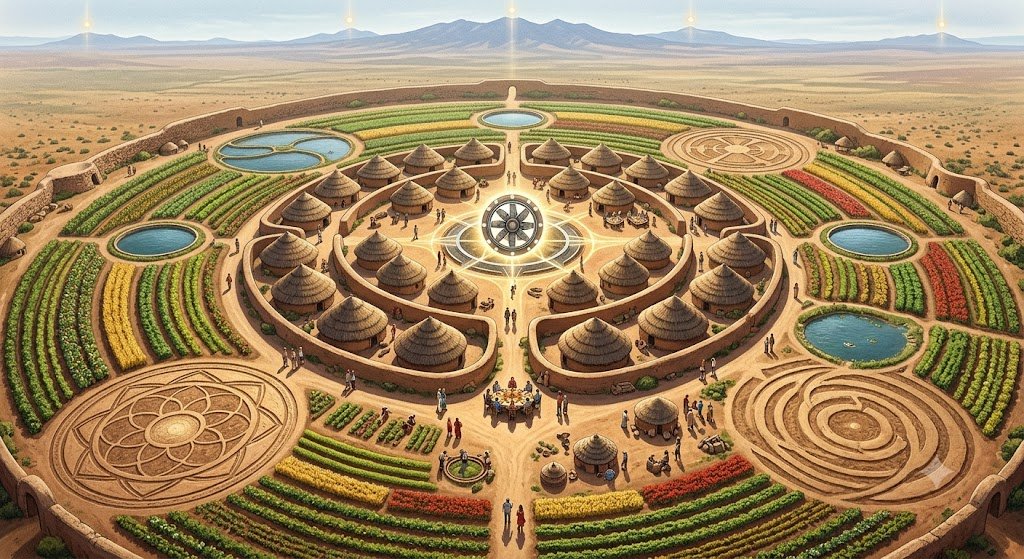
The Circular Village: We organize in a formation that creates strength, where every home is a part of the perimeter.
The Circular Harvest: Our production cycles move in harmony with our defense, ensuring the land is always covered.
The Mission: When one village flourishes, the impact ripples outward, strengthening the neighboring rings and securing the Frontier for all.

THE HARMONIC VILLAGE: CIRCULAR FARMING DYNAMICS
Circular farming—often referred to as circular agriculture—improves efficiency by shifting away from the traditional, linear “take-make-dispose” model (where resources are used once and then discarded) toward a closed-loop system that mimics natural ecological cycles.
The efficiency gains you see mentioned in your current webpage’s context, specifically regarding the “33-node circular village model,” stem from several core principles:
1. Resource Regeneration and Waste Minimization
In a circular system, the “waste” from one process becomes the input for another.
Nutrient Cycling: Instead of relying heavily on external synthetic fertilizers, circular farms use organic waste (like crop residues or animal manure) to enrich the soil, reducing the need for purchased inputs and lowering costs.
Reduced Inputs: By closing these loops, the system requires fewer raw materials from outside the farm, insulating it from supply chain disruptions and price volatility.
2. Space and Logistical Optimization
As highlighted in your text regarding “continuous flow farming,” circular designs often optimize physical layouts:
Eliminating Inefficiencies: Traditional “block-farm” methods often involve frequent stopping, turning, and maneuvering of heavy machinery, which wastes fuel and increases equipment wear.
Continuous Production: Circular or spiral patterns allow equipment to operate in continuous, uninterrupted paths. This reduces the energy, time, and mechanical stress associated with constant starting and stopping, directly contributing to the 40% reduction in fuel and wear noted in your document.
3. Energy Integration
Circular models aim to decentralize energy production to match local consumption.
Localized Power: By integrating power generation (like the “Atmag Genset” mentioned) directly into the farm or village nodes, the system eliminates transmission losses and the financial burden of centralized utility dependence.
Resilience: This localized approach ensures that energy remains available even if the larger, centralized power grid experiences failures.
4. Vertical Integration (Prosumer Nodes)
The model described encourages the concept of “Vertical Sovereignty.” * Rather than simply selling raw commodities—which often results in lower profit margins—farmers or homesteaders are encouraged to process, store, and distribute goods within the same localized network.
This keeps the value added during processing within the community, rather than leaking it out to external middlemen or industrial-scale transport chains.
Summary of Efficiency Impacts
| Feature | Traditional Linear Model | Circular/Harmonic Model |
| Inputs | High (External fertilizers/energy) | Low (Regenerated/Recycled) |
| Waste | Discarded as byproduct | Reintegrated as resource |
| Logistics | Stop-and-start / High fuel cost | Continuous flow / Lower fuel cost |
| Value Chain | Raw commodity export | Localized processing/Prosumer node |
DIRECTIVE: The WWEHFELS Mandate
MISSION STATEMENT: To secure the survival, sovereignty, and prosperity of the American Frontier by deploying the WWEHFELS (Wind, Water, Electricity, Health, Food, Energy, Land, Security) infrastructure nexus. We do not negotiate with scarcity; we engineer it out of existence.
THE OPERATIONAL IMPERATIVE: The current centralized model of dependency is a failure. WWEHFELS is the transition from a failing grid to a sovereign existence. We provide the permanent infrastructure that allows individuals, and veterans to own their wind, water, power, and food—forever.
THE PILLARS OF SOVEREIGNTY:
W – Wind: Kinetic atmospheric harvesting. Theron Air
W – Water: Molecular atmospheric syncing. Theron H2O
E – Electricity: Permanent Magnetic Generation (The end of the grid). Theron Energy
H – Health: Horticultural and biological sovereignty and resilience thru vertical farming. Theron Horticulture
F – Food: High-yield Direct from Harvest to Consumer Food thru and circular farming. Wheels 4 Veterans
E – Solar Energy: The conversion of energy from sunlight into electricity, directly using photovoltaics (PV) or indirectly using concentrated solar power. Theron Solar
L – Land: Land ownership and home ownership throughout the world to secure a legacy for a lifetime of work. Theron Ranch, Caesarea
S – Soil: It is the physical boundary, the locks, and the perimeter that ensure life, living, and sustenance. Theron Soil
The Covenant of the New Frontier
Infrastructure is merely the frame; the life of the land is the people. The WWEHFELS nexus does not just provide power and water—it creates the conditions for a New Thanksgiving.
For generations, the stories of the American frontier were defined by the shared labor of the harvest and the deep, communal gratitude that follows. We are returning to that tradition. By working this land together, we are ending the era of centralized scarcity and isolation. As a veteran seeking a new mission and absolute independence, you are a steward of this covenant.
The land is ready. The table is set. Welcome home to the Heartland of America.